What’s in a Name?
What’s the last thing that stressed you out?
Chances are it’s one of the following: your job, your finances, your relationship, or your well-being. While these are common anxieties, they’re anything but simple to fix.
That’s why the University of Georgia’s Love and Money Center for Relational and Financial Well-Being—better known as the Love and Money Center—is such an apt name. It clearly signals a place designed to help people navigate some of life’s most complicated challenges.
Meeting People Where They Are
Situated on South Campus, housed within the UGA College of Family and Consumer Sciences (FACS), the center features eight comfortable rooms for individuals, couples, or families who have already taken the hardest step: asking for help.
There’s no shortage of people who need it. What’s in short supply is the number of professionals available to give it. Enter the Love and Money Center, where the next generation of helping professionals is learning how to meet that need.
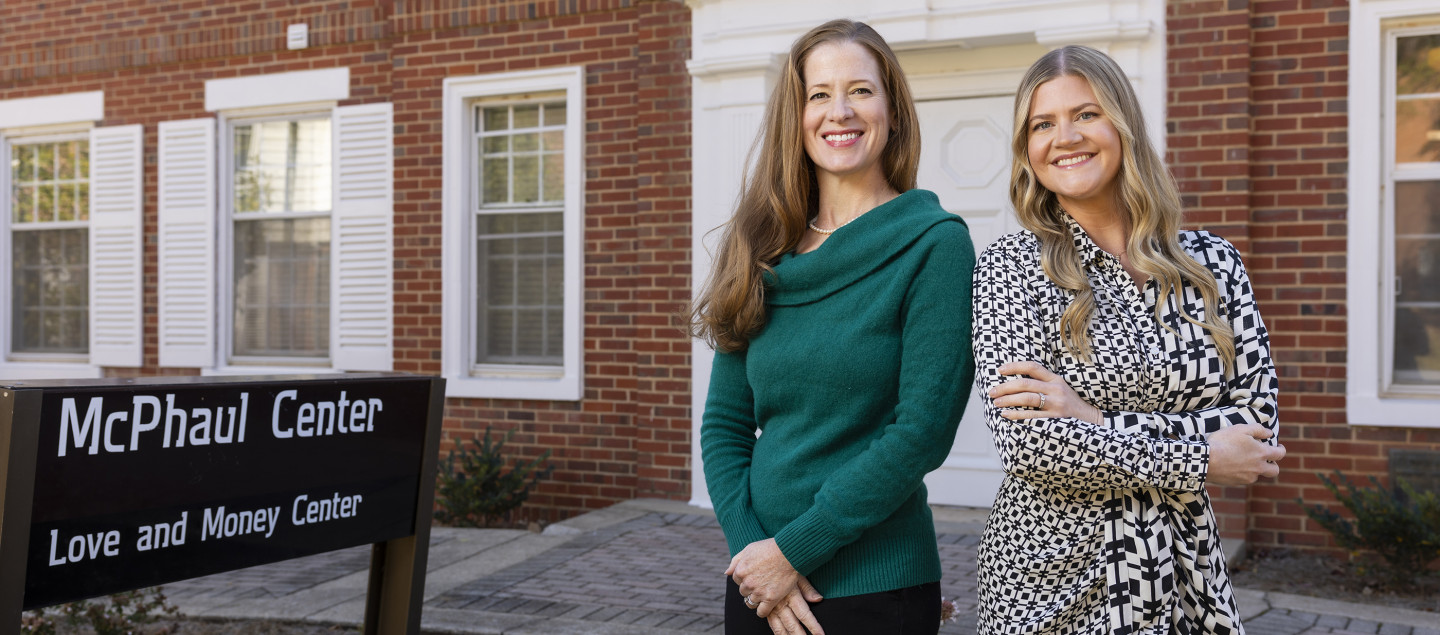
“There are not enough trained mental health and financial professionals to meet the need in our state. We are dedicated to changing that story. We train our students to be compassionate and smart, and to have a systemic lens to really know how change happens,” says Christine Hargrove PhD ’24, the center’s assistant director. “What does it feel like to get better? If you have an idea of what the end game is—because you actually have some exposure to it through a center like this—it is so much easier to keep the end in mind and to have that ongoing momentum.”
Since its launch in 2009, the center has helped more than 3,000 people, offering specialized assistance in individual mental health, couple and family therapy, financial planning, or any combination of the above.
While some clients seek to solve one-off problems, others require a dozen dedicated sessions or may even come back to the center with a different issue years later.
It’s not just love or money (or both), however. The center houses a dedicated team of professionals-in-training who offer broad counseling on everything from navigating trauma to managing anxiety and depression to improving work-life balance.
All the center’s services are either free or based on a sliding scale that is significantly lower than similar options without insurance.
The center also delivers services virtually, which not only fills a critical gap but also reflects its mission to reach as much of the community as possible.
“Clients can expect to feel embraced for where they are at this moment. That is our hope,” says center director Megan Ford PhD ’22. “It can be difficult and scary to approach change in your financial situation, your relationship, or your relationship with self. That can be tough, so I think first and foremost, we hope that people feel the warmth, acceptance, and dignity we provide.”
Tomorrow’s Practitioners Today
The Love and Money Center is appreciated not just for the outcomes it gives clients but also the opportunities it gives its students and faculty.
More than 550 undergraduate and graduate students across disciplines in FACS and beyond, get hands-on experience through the center before they enter their chosen fields. They observe interactions and conduct mock sessions. Some even provide services under the supervision of licensed professionals before they graduate.
“Part of our mission is to ensure that students feel more prepared for their career and go into it with eyes wide open. Many of them are out there as licensed or certified practitioners now serving their communities, and it’s just a really beautiful thing to see,” Ford says.
Faculty, too, are constantly evaluating how effective training at the center can be. If there are new tools or methods that could improve the work done at the intersections of love and money, Ford says they likely came from folks at the center.
One of those innovations is the emerging field of financial therapy. Rather than treating finances and emotional well-being as separate issues, the Love and Money Center has been a leading advocate for integrating the two, and it is one of the only centers in the country doing so.
“Financial therapy is not only what’s wrong, but what are we going to do about it? There are lots of complicated issues with money,” says Hargrove.
Love and Money and …
The center began its work many years ago as the McPhaul Marriage and Family Therapy Clinic. Then, it was known as the ASPIRE Clinic, an acronym that was easier to remember than its unwieldy official name: Acquiring Strategies for Personal Improvement and Relationship Enhancement. In 2024, FACS officially rebranded the ASPIRE Clinic as the Love and Money Center.
Name changes aside, the center’s mission has stayed the same: help community members find holistic solutions to common but complex personal problems.
“We wanted to refine our identity to make ourselves more identifiable for what we’re about and what we excel at,” Ford says. “Those two words—love and money—are ones that people immediately get. And if people don’t understand what we do, if we’re not relevant and meeting the needs that exist right now, then we’re missing the point of why we’re here.”
The new name for the center is setting the stage for its next chapter. As times become more complicated, the center offers approachable, client-centered solutions.
With such a significant focus on financial therapy, the Love and Money Center is poised to become the premier destination for training and research in this field of study, with two notable publications already coming out of the center’s data.
Ford says that as the UGA School of Medicine, School of Nursing, and FACS’s new Ralston Institute on Behavioral Health and Developmental Disabilities come to fruition, the university’s ability to help Georgians will only grow. And that’s pretty exciting for folks at the Love and Money Center.
“The rebrand was really just a next step, a next iteration in this journey to serve, research, and teach holistically,” she says. “This space is one of a kind. We want the Love and Money Center to be known nationally and internationally as the hub for relational and financial well-being.
“We’re not ambitious whatsoever,” Ford laughs.
This article was written by Savannah Peat and appears in the spring 2026 issue of Georgia Magazine.