
Money affects nearly every aspect of your life - yet most of us never learned how to manage it with confidence or clarity.
At the Love and Money Center, our student financial planners help you build a healthier relationship with money through collaborative, educational, and coaching support. Whether you’re working to understand your spending patterns, create a sustainable budget, tackle debt, identify personal insurance needs, explore investing, plan for retirement, navigate conflict around money, or simply feel less stressed about your finances, we provide judgment-free, personalized guidance — completely free of charge.
We work with you across multiple sessions, tailored to your goals and grounded in a fiduciary standard of care where your best interests are front and center. Our approach combines technical financial knowledge with behavioral finance and financial therapy insights, so you gain clarity and the tools to follow through on what matters most to you.
Financial Planning & Coaching Services

Finances can feel overwhelming, whether you’re struggling to stick to a budget, looking for strategies to repay debt, unsure where your money goes, navigating a major decision, thinking ahead to retirement and investing, or feeling anxious about money. We understand that money is not just about numbers — they’re about habits, emotions, and patterns that often have deep roots.
Our student financial planners are trained in both technical financial planning and behavioral skills. They work with you across multiple sessions on cash flow, budgeting, debt management, insurance, investing, retirement, goal-setting and more. Drawing on insights from behavioral finance and financial therapy, they help you understand your choices, explore options, and build sustainable follow-through — all in a collaborative process where you will learn about yourself and your money.
Whether you’re facing an immediate money challenge or want to build long-term financial health and confidence, our student financial planners offer practical tools and judgment-free support — at no cost to you.
FAQs
- What are your hours?
- Where are you located?
- Where should I park? Do I have to pay for parking?
- I’m not in Athens. I’m not even in Georgia. Can I still request services?
- What are the fees for financial planning and coaching services?
- What are your hours?
We offer appointments on:
- Mondays – Thursdays from 9 a.m. – 8 p.m. (last appointment begins at 7 p.m.), and
- Fridays from 9 a.m. – 5 p.m. (last appointment begins at 4 p.m.).
We do not offer services when the University of Georgia is closed (e.g., holidays, inclement weather) and at various times throughout the year (clients are provided with advanced notice).
- Where are you located?
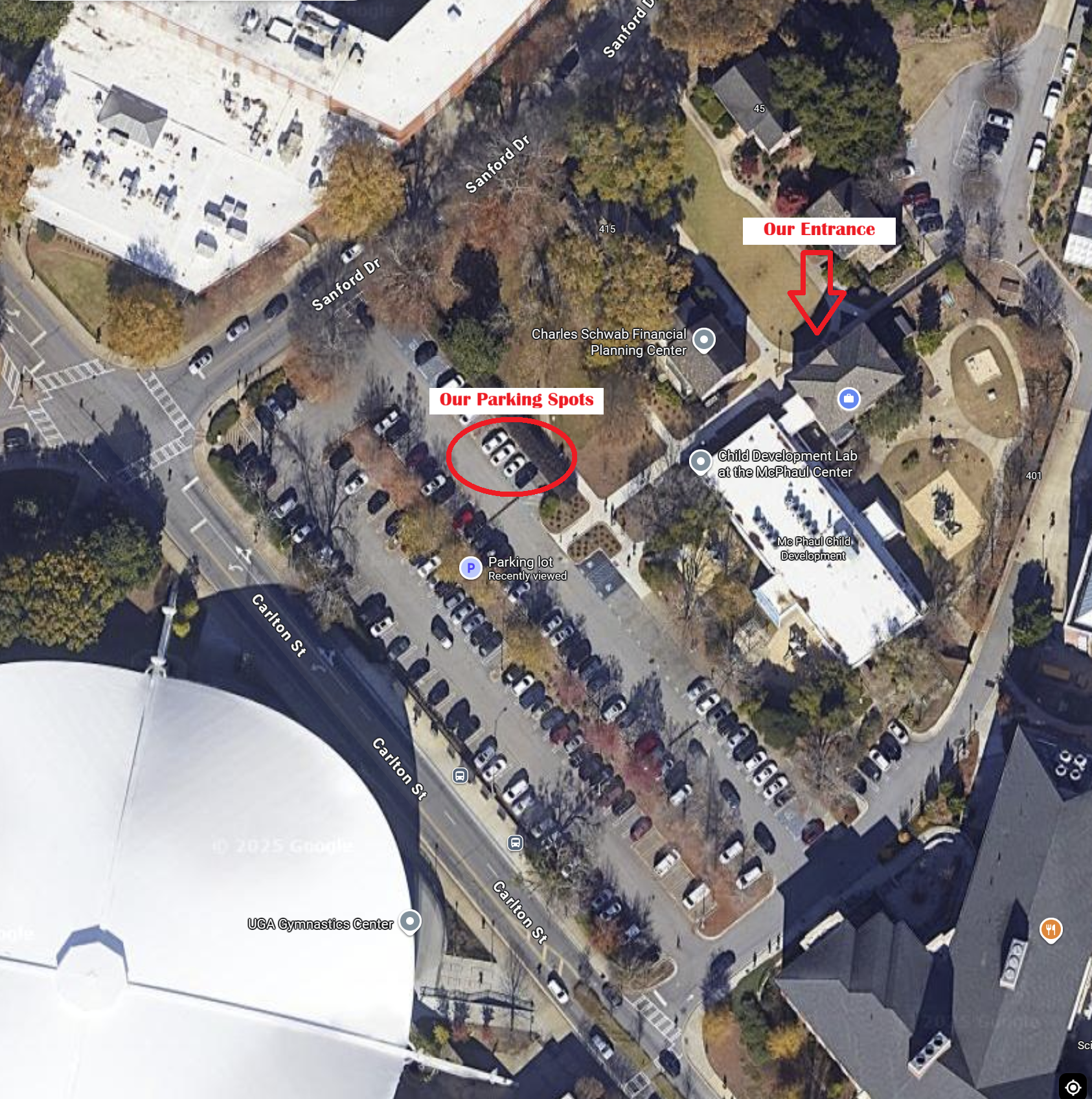
The Love and Money Center operates in two locations on South Campus. Our main offices, front desk, and lobby are in the McPhaul Center at 202 Carlton St., Athens, GA 30602. We also maintain clinical space at the Charles Schwab Center next door.
- Where should I park? Do I have to pay for parking?
You can park for free in lot S10 next to the McPhaul Center. Park in the spots that have signs marking them as reserved for the Love and Money Center.
When you check in at the front desk, we will give you a parking pass to place on your car dashboard while you attend your appointment. This pass will only be good for the duration of your appointment time.
- I’m not in Athens. I’m not even in Georgia. Can I still request services?
Yes! We offer our financial planning and coaching services throughout the United States via videoconferencing.
- What are the fees for financial planning and coaching services?
Free.

When It's More Than Money
Financial challenges often come with anxiety, relationship conflict, or stress that affects your overall well-being. If you're finding that your struggles with money are connected to deeper emotional patterns or relationship dynamics, our individual, couple, and family therapy services can help. Sometimes the path to financial health includes addressing what's underneath.